Regulatory requirements for the maritime market
For many years, Hectronic has developed embedded computer systems for maritime and offshore applications. A key part of every project is designing systems that meet the rules, standards and certification requirements for marine equipment.
Developing a marine embedded system?
Meeting IEC 60945 and IACS UR E10 requirements can be challenging.
From concept and hardware development to testing, documentation and type approval, we support customers throughout the development process.

Offshore Computer - Rugged Computer
IACS E10 Rev.7
IACS is an abbreviation for the International Association of Classification Societies. It is a non-profit classification organization consisting of twelve members, that sets the standards and demands for marine safety, environmental protection and ensure consistent adaption.
IACS has been around for over 90 years and they regularly update the demands on classifications. Most recently launched IACS E10 Rev. 7. The latest review needed to be implemented by 2020 to all IACS members different specifications. By January 2022, all new equipment that are assembled on boats and ships needs to meet the new demands.
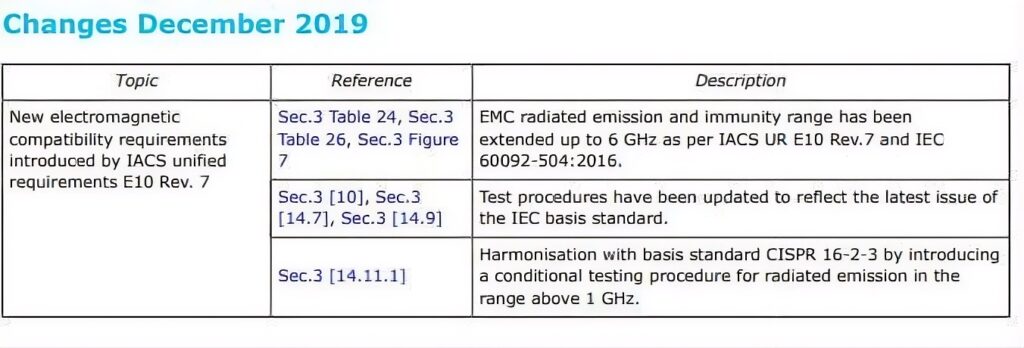
There are not that many differences in Rev. 7 from Rev. 6, but there is a few that needs to be highlighted. One significant difference is that the frequency range for EMC testing of emission and immunity has been extended from 2000 Mhz to 6000 MHz.
One of IACS members, DNV, has taken the new guidelines into precaution in their updated demands (DNVGL-CG-0339 Dec 2019). There you can read the following:

Offshore Computer - Rugged Computer
Regulatory requirements
Maritime and offshore applications are governed by IEC 60945 and the IACS E10 test specification for marine type approval
Requirements include the following main areas:
• Electro Magnetic Compatibility
– Radiated and conducted emission
– Radiated and conducted susceptibility
– Electrostatic discharge
– Compass safe distance
• Operating temperature ranges
– +5°C to +55°C up to -25°C to +70°C
• Shock and vibration
– Propeller vibration and wave slamming
• Corrosion from exposure to salt mist
• IP Code for protection against water, dust or objects coming in contact with hazardous parts in the system
The IEC-60945 specifies four different product categories. Products are categorized based upon their location on board and requirements and test cases are adapted accordingly. The categories are:
• Portable
• Protected
• Exposed
• Submerged


Offshore Computer - Rugged Computer
Testing and type approval
There are a lot of steps you need to take to get your marine computers certified. Here you can read more about the requirements and how Hectronic can help you to certify your next marine computers.
Accredited laboratory
This means that the lab is approved by authorized organizations to carry out the required tests. It is not always a requirement that the lab is accredited, but it almost always is when it comes to tests regarding certifications. Even though it isn’t a requirement, an accredited laboratory makes the testing easier.
Compliant
This means that the product is designed with the requirements in mind and is tested according to required standards. But this doesn’t mean that the product is certified. There are a lot of suppliers that sell marine controllers labelled as “compliant” to the requested standard. But this still means that the buyer needs to get the product certified themselves.
Certified – Type approval
When a product is certified it has been type approved and is listed by authorized organization. For example, if you are certifying a product according to DNV, only DNV can carry out the certification. The same goes for Bureau Veritas, American Bureau of shipping, and all other members of IACS. They are the only instances who can certify according to their own standards.
When Hectronic develop a product that needs to be certified we always do all tests at an accredited laboratory. When the product has been tested, we get a report that confirms it has been tested and meet all necessary demands. Still, this doesn’t mean that the product is certified. Now the report needs to be sent to the authorized organization in charge of the standard. Only when they have approved the report, the product can obtain its type approval and will be registered as certified on the authorized organizations web site.
Developing embedded computer systems that meet IEC 60945 and IACS E10 requirements is part of what we do every day. If you’re planning a new project, we’d be happy to discuss it.